
Information about the zones introduced around commercial centres, and within the Central City, to accommodate housing growth, which came into effect in 2025 as part of Plan Change 14.
For background information about Plan Change 14 (Housing and Business Choice), please visit our PC14 page.

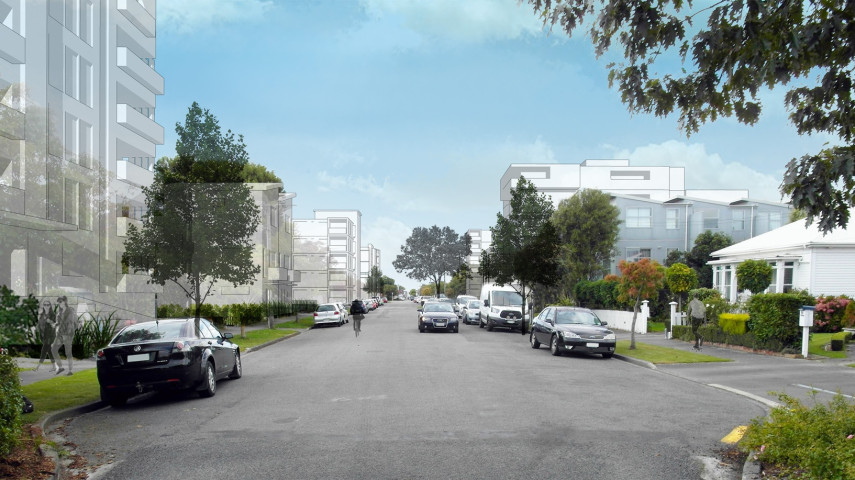
Multi-unit housing design guidance has been developed to help ensure new medium- and high-density townhouses and apartments work well for residents, neighbours, and the wider community.
Medium Density Residential Zone
Medium-density residential intensification is expected in this zone, which is generally located around the city’s smaller and medium-sized commercial centres and select public transport routes.
It allows three- or four-storey buildings, including semi-detached and terraced housing, low-rise apartments, and comprehensively designed, larger residential developments.
Existing sites can be redeveloped individually or combined for larger developments.
- Three houses per site.
- Building height of 11m, plus 1m for the roof.
- 1m building setback from side and back boundaries, including balconies and upper-floor windows facing adjoining properties. Some garages and other accessory buildings can be built right next to the boundary.
- 1.5m setback from road boundaries.
- 50% building coverage of the site (the area of land covered by buildings).
- Daylight recession planes starting from a height of 4m on the boundary, then at a 60° angle.
- 30m building length.
- Outdoor living space of 20m2 for ground-floor units or 8m2 for above-ground units, with reduced sizes for studio units and communal options possible.
- No minimum required land area for existing or proposed units, or 400m2 when subdividing off a new vacant site.
- Any development of four or more houses requires a resource consent focused on urban design outcomes, known as Residential Design Principles.
- Consent is also needed if any other rules aren’t met.
- Rules in the District Plan set the triggers for when a consent is required. They are a starting point for assessment rather than a hard-and-fast limit on what is possible to construct – if a proposal goes beyond what the rule states, an application is still able to be approved if the development generally fits with the purpose of the zone and the rule(s) breached.
- The type of consent is usually classified as a ‘Restricted Discretionary Activity’. This means that the matters a development must address are specified in the District Plan, and the Council can only take into account those matters when considering the effects of the development and whether neighbours are affected.
- When assessing effects on neighbours, the Council must consider the purpose of the zone and the level of development allowed by the rules.
- Most applications for resource consent are not notified to neighbouring properties, meaning written approval from neighbours isn't required.
- The number of houses or units in itself doesn’t trigger the need for neighbour approval – it’s the effects of any other rules breached, and how these compare to the effects of a complying building. These rules include height, daylight recession planes, setback of buildings from boundaries, and building length.
- If a rule is breached but the effects aren’t noticeably different to a building that doesn’t breach the rule, the Council is not allowed to consider the neighbour affected. For example, a building that partly exceeds the 11m height limit, but a shading diagram shows that its shading will be no different to what could be built as of right, and the extra height doesn’t result in any greater effects on privacy or visual dominance for a neighbour.
- If neighbours are considered to be affected, their written approval will be needed, otherwise, the application must go through a notified application process. The other option is to amend the plans so the neighbours are no longer affected.
More information about public involvement in the resource consent process.
The Local Centre Intensification Precinct (LCIP) applies over Medium Density Residential-zoned areas surrounding the following Local Centre zones:
- Barrington
- Bishopdale
- Halswell
- Richmond
- Prestons
- North West Belfast
- Wigram
- Sydenham South
See the planning maps(external link) for where the LCIP is located in these zones.
The LCIP rules encourage ‘Perimeter Block’ development, also known as terraced housing, where buildings have shared walls along a road frontage, and outdoor living areas at the back.
Within the LCIP, there is no daylight recession plane along the first part of the property boundary from a road (20m or 60% of the boundary length, whichever is less) for any development of three units or more.
High Density Residential Zone
High-density residential intensification is expected in this zone, which is located around the 10 largest commercial centres in the city and allows apartment buildings of up to four or five storeys (14m).
Combining existing properties is encouraged to enable greater intensification. Building height for this zone is further increased within the Central City (four avenues).
- Outside the Central City, buildings up to 14m in height are permitted.
- Developments of three or more units must be at least 7m high.
- More flexible recession plane rules (i.e. height in relation to boundary) across the zone, as follows:
- No recession plane applies along the first part of a property’s boundary from the road (20m or 60% of the boundary length, whichever is less) for developments of three or more units. This is the same as the Local Centre Intensification Precinct but with a greater permitted building height of 14m.
- No recession plane applies for parts of buildings 12m or taller if they’re set back 6 to 8m from the side and rear boundaries, depending on site orientation.
- Buildings above 12m tall on the same site must be separated by at least 10m.
- Greater building coverage is permitted up to 60% if all of the following apply:
- The total development site is at least 25m wide.
- No onsite parking is provided (except loading and accessible parking, as required).
- Additional landscaping is provided.
- The 20% landscaping requirement can be provided as the total area across the site if landscaped areas are at least 0.6m wide.
- No minimum site area for existing or proposed units, or 300m2 for vacant sites.
- Any development of four or more houses requires a resource consent focused on urban design outcomes, known as Residential Design Principles.
- Consent is also needed if any other rules aren’t met.
- Rules in the District Plan set the triggers for when a consent is required. They are a starting point for assessment rather than a hard-and-fast limit for what can be constructed – if a proposal goes beyond what the rule states, an application is still able to be approved if the development generally fits with the purpose of the zone and the rule(s) breached.
- The type of consent is usually classified as a ‘Restricted Discretionary Activity’. This means that matters a development must address are specified in the District Plan, and the Council can only take into account those matters when considering the effects of the development and whether neighbours are affected.
- When assessing effects on neighbours, the Council must consider the purpose of the zone and the level of development allowed by the rules.
- Most applications for resource consent are not notified to neighbouring properties, meaning written approval from neighbours isn't required.
- The number of houses or units in itself doesn’t trigger the need for neighbour approval – it’s the effects of any other rules breached, and how these compare to the effects of a complying building. These rules include height, daylight recession planesand setback of buildings from boundaries.
- If a rule is breached but the effects aren’t noticeably different to a building that doesn’t breach the rule, the Council is not allowed to consider the neighbour affected. For example, a building that partly exceeds the 14m height limit, but a shading diagram shows that its shading will be no different to what could be built as of right, and the extra height doesn’t result in any greater effects on privacy or visual dominance for a neighbour.
- If neighbours are considered to be affected, their written approval is needed, otherwise the application must go through a notified application process. The other option is to amend the plans so the neighbours are no longer affected.
More information about public involvement in the resource consent process.
High Density Residential Zone in the Central City
The High Density Residential Zone within the Central City (four avenues) provides for a substantially higher building form when compared to the High Density Residential Zone located around suburban commercial centres.
Large-scale development of six to 12 storeys is expected, with a greater concentration of height around the commercial centre of the Central City.
- Either 22m or 39m building heights are permitted, depending on the location.
- The Central City Residential Precinct, located around the commercial core of the Central City (City Centre Zone), permits 39m residential development (about 12 storeys).
- Other parts of the High Density Residential zone not within the precinct allow 22m residential development (about six storeys).
- Additional building height is provided, as above; however, a minimum of two storeys (7m) applies to any comprehensive residential development (i.e. three or more units).
- More flexible recession plane rules (i.e. height in relation to boundary) across the zone, as follows:
- No recession plane applies along the first 20m of a parcel boundary from the road (20m or 60% of the boundary length, whichever is less) for developments of three or more units.
- No recession plane applies for parts of building 12m or taller if they’re set back 6 to 8m from the side and rear boundaries, depending on site orientation.
- Buildings above 12m tall on the same site must be separated by at least 10m.
- Greater building coverage is permitted at up to 60% if all of the following apply:
- The total development site is at least 25m wide
- No onsite parking is provided (except loading and accessible parking, as required)
- Additional landscaping is provided.
- The 20% landscaping requirement can be provided as a total area across the site if landscaped areas are at least 0.6m wide.
- Any development of four or more houses requires consent focused on urban design outcomes, known as Residential Design Principles.
- Consent is also needed if any other rules aren’t met.
- Rules in the District Plan set the triggers for when a consent is required. They are a starting point for assessment rather than a hard-and-fast limit for what can be constructed – if a proposal goes beyond what the rule states, an application is still able to be approved if the development generally fits with the purpose of the zone and the rule(s) breached.
- The type of consent is usually classified as a ‘Restricted Discretionary Activity’. This means that the matters a development must address are specified in the District Plan, and the Council can only consider those matters when considering the effects of the development and whether neighbours are affected.
- When assessing effects on neighbours, the Council must consider the purpose of the zone and the level of development allowed by the rules.
- Most applications for resource consent are not notified to neighbouring properties, meaning written approval from neighbours isn't required.
- The number of houses or units in itself doesn’t trigger the need for neighbour approval – it’s the effects of any other rules breached, and how these compare to the effects of a complying building. These rules include height, daylight recession planes and setback of buildings from boundaries.
- If a rule is breached but the effects aren’t noticeably different to a building that doesn’t breach the rule, the Council is not legally allowed to consider the neighbour affected. For example, a building that partly exceeds the height limit, but a shading diagram shows that its shading will be no different to what could be built as of right, and the extra height doesn’t result in any greater effects on privacy or visual dominance for a neighbour.
- If neighbours are considered to be affected, their written approval is needed, otherwise, the application must go through a notified application process. The other option is to amend the plans so the neighbours are no longer affected.
More information about public involvement in the resource consent process.