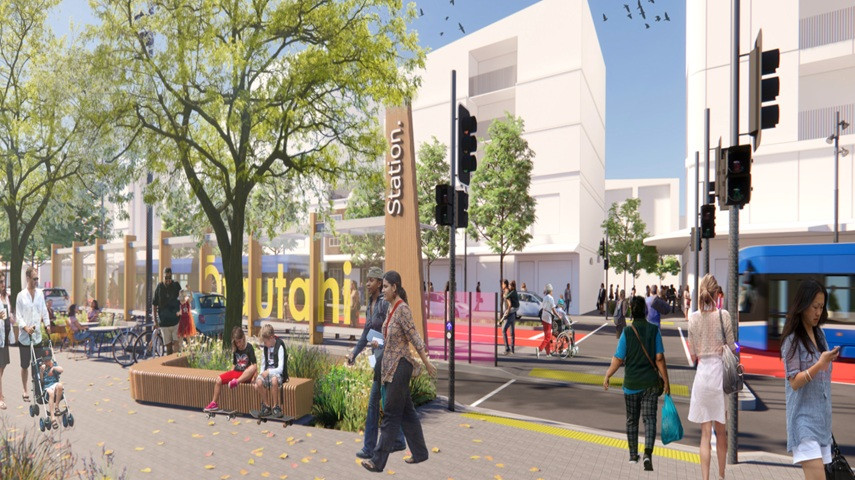
Mass Rapid Transit (MRT) is central to delivering Greater Christchurch’s vision of a well-functioning, prosperous, sustainable city with strong transport options.

Sign up to the Mass Rapid Transit newsletter

Mass Rapid Transit (MRT) is a high-capacity, quick, frequent and reliable public transport service that operates on a dedicated route, largely separated from other traffic.

The Greater Christchurch Partnership (GCP), made up of local councils, mana whenua and government agencies, is planning for the future of Ōtautahi Christchurch by investing in public transport.

Mass Rapid Transit is an investment that will shape our city for generations - making Greater Christchurch more connected and easier to get around.

As our city grows, regular buses mixing with traffic won’t meet demand, so a higher-capacity public transport system – Mass Rapid Transit - is needed. We’re designing a turn-up-and-go mass rapid transit service that reflects what our communities have asked for: a city that’s easy, safe and enjoyable to live in and move around.

Mass Rapid Transit also supports development to happen in the right places. It enables housing and employment in key centres, with a third of Greater Christchurch’s population potentially living along the mass rapid transit route in the future.

It is also a key component of the Greater Christchurch Spatial Plan. This plan sets out the pathway for enabling the Greater Christchurch population to grow to 700,000 residents over 30 years.

In June 2025, Christchurch’s MRT project(external link) was named on a list of nationally important infrastructure works. It was deemed to be of national importance by meeting New Zealand’s strategic objectives, being good value for money, and capable of being successfully delivered.

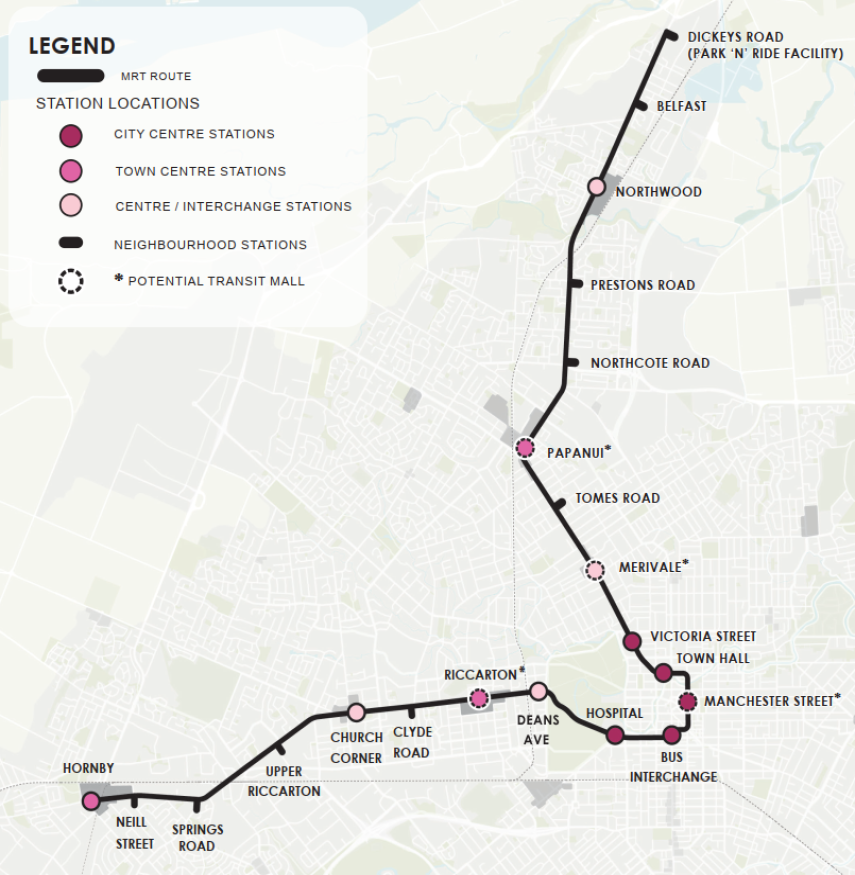
In 2023, as part of the Spatial Plan, the Greater Christchurch Partnership developed a business case confirming that Mass Rapid Transit (MRT) will be essential as the city grows toward a population of 700,000. With feasibility studies complete, the next step is protecting the proposed 22km Hornby-to-Belfast route, via the central city.

The route, containing 21 stations, has been chosen as Riccarton and Papanui roads are already Christchurch’s busiest public transport routes, carrying thousands of passengers daily. It will also help housing and business development to occur in the right places and improve access to key employment areas, including the central city.

To improve connections between Christchurch and surrounding areas such as Rolleston and Rangiora, we are investigating ‘park and ride’ facilities in Hornby and Belfast.

The MRT route, containing 21 stations located at Hornby, Neil Street, Springs Road, Upper Riccarton, Church Corner, Clyde Road, Riccarton, Deans Ave, the Hospital, the Bus Interchange, Manchester Street, the Town Hall, Victoria Street, Merivale, Tomes Road, Papanui, Northcote Road, Prestons Road, Northwood, Belfast and Dickeys Road.

Route protection

Work is underway on developing a Route Protection Detailed Business Case for MRT. This involves identifying any additional land needed for MRT and securing it through a legislative process to prevent future development.

To minimise disruption, we’re aiming to prioritise publicly owned land, though some private land may need to be designated to protect future options. If land designations are required, we will follow the formal consultation process set out in legislation. This would involve us working closely with property owners and stakeholders throughout the process.

In 2023, the Greater Christchurch Partnership Whakawhanake Kāinga Committee ran an engagement survey, Huihui Mai(external link), to find out what residents thought about important issues, including MRT.

More than 7,000 people completed the online survey. Respondents were asked whether we should focus growth around key urban and town centres and along public transport routes in the future, with 86% agreeing we should. 

They were also asked whether they agreed with the proposed route. Overall, 53% supported the proposed route, with 24% not agreeing and 23% not being sure.

Agreement with the route varied significantly by where people live – 72% of respondents who live in suburbs along the route and 62% of people who live in north-west Christchurch agreed with the suggested route, while only 38% of people from the Selwyn District and 44% of people from Waimakariri District agreed.

People who live in northeast Christchurch were also less likely to agree with the suggested route, with only 46% of people in agreement.

2017

A strategic business case recommending greater investment into public transport in Christchurch was endorsed by Christchurch City Council and the New Zealand Transport Agency (NZTA).

2018

A programme business case, recommending investment that included MRT as a longer-term necessity, was endorsed by Christchurch City Council and NZTA.

2023

An indicative business case looking into MRT in more detail was endorsed by Christchurch City Council, Selwyn District Council, Waimakariri District Council, Environment Canterbury, Greater Christchurch Partnership and NZTA.

2025

Te Waihanga Infrastructure Commission further endorsed the project(external link) to the central government through inclusion in the draft National Infrastructure Plan(external link).

2017

A strategic business case recommending greater investment into public transport in Christchurch was endorsed by Christchurch City Council and the New Zealand Transport Agency (NZTA).

2018

A programme business case, recommending investment that included MRT as a longer-term necessity, was endorsed by Christchurch City Council and NZTA.

2023

An indicative business case looking into MRT in more detail was endorsed by Christchurch City Council, Selwyn District Council, Waimakariri District Council, Environment Canterbury, Greater Christchurch Partnership and NZTA.

2025

Te Waihanga Infrastructure Commission further endorsed the project(external link) to the central government through inclusion in the draft National Infrastructure Plan(external link).